
Startup accelerator applications repeat a familiar set of questions: What does the company do? Who are the founders? What problem are you solving? Who are the competitors? What traction have you reached? Where is the pitch deck?
The repetition makes an AI form filler for startup accelerator applications attractive. But the application is also an investor-facing record of the company at a specific moment. A stale revenue figure, invented customer claim, wrong cap-table answer, or generic explanation of program fit can do more damage than a blank field.
SmartAutoFill fits the narrow space between those two facts. It can draft and fill compatible browser fields from an approved company profile for review. It should not decide which program deserves an application, fabricate a stronger story, accept investment or privacy terms, disclose another founder's information without permission, or submit the form.
The target customer and the real purchase intent
The target ICP is a founder or startup operations lead preparing a small number of serious accelerator, incubator, fellowship, or pitch-competition applications. The company already has a source of truth, such as a current pitch deck, founder bios, a metrics snapshot, and approved descriptions of the product and market.
The purchase intent is not "apply everywhere for me." It is:
- Reuse stable company and founder facts without retyping them.
- Keep recurring answers consistent across different portal layouts.
- Draft ordinary fields from one selected company context.
- Preserve enough time and attention to tailor the high-judgment answers.
- Review every value before the application leaves the browser.
This distinction matters. Techstars' application preview says its application covers basic founder information, company information, and optional accelerator selection. It also warns that submitting multiple applications does not improve the chance of acceptance. That is a useful buying signal: quality and fit matter more than raw submission volume.
Why accelerator forms are not one reusable template
Accelerator applications mix four different data classes.
Stable company facts
These include the legal or trading name, website, headquarters, incorporation date, product category, founder names, roles, profile links, and a concise company description.
Time-sensitive operating facts
Revenue, active users, growth, runway, headcount, amount raised, fundraising status, and customer counts can change weekly. They may be reusable for a short period, but only with an "as of" date and an accountable owner.
Program-specific judgment
"Why this accelerator?", "What do you want from the program?", location commitments, cohort availability, sector fit, and mentor needs must be answered against the current program. Reusing a generic paragraph can signal that the founder did not read the brief.
Sensitive or consequential information
Cap table details, ownership percentages, investor names, legal disputes, tax identifiers, banking data, background declarations, privacy consent, and investment terms need deliberate handling. They are not ordinary autofill material.
Public accelerator portals show how much the mix varies. Techstars asks founders to focus on character limits while explaining the team, market, progress, and idea. Public F6S application pages may also request competitors, traction, program goals, a business plan or pitch deck, attendance commitments, and confirmation of program-specific terms. The field names can look reusable even when the truthful answer has changed.
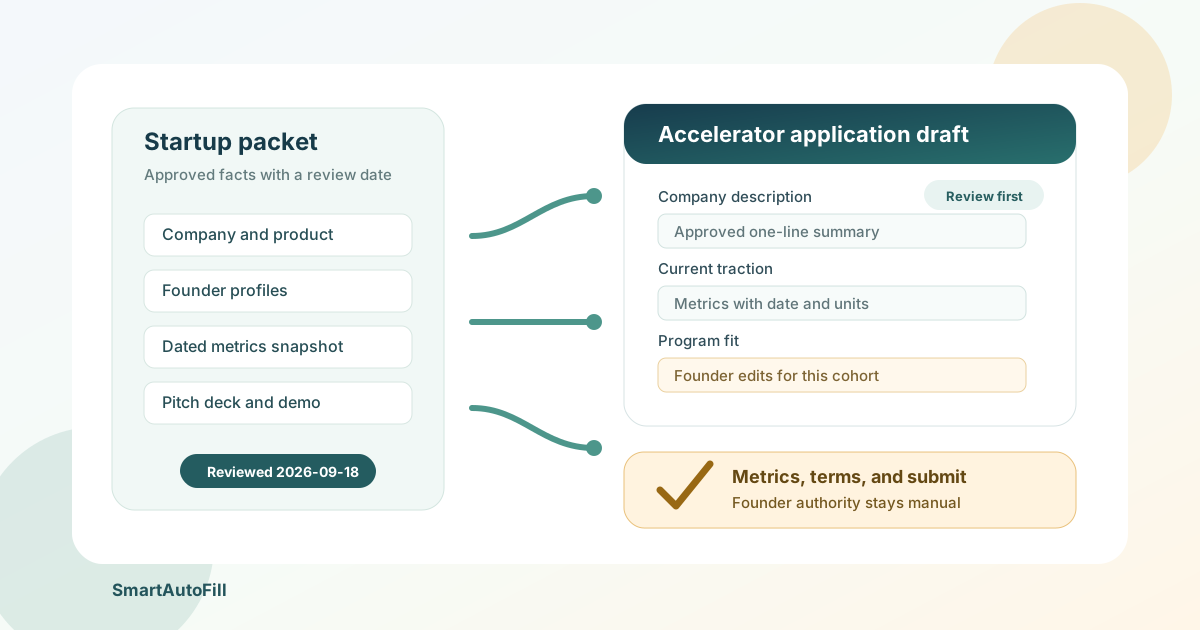
Build a dated startup application packet
Do not begin with a giant personal profile assembled from old applications. Create a compact, reviewed packet for the company and date it.
Startup profile
Company: Signal Harbor, Inc.
Website: https://example.com
Founded: 2025
Headquarters: Toronto, Canada
One-line description: Monitoring software for cold-chain logistics teams.
Problem: Small operators discover temperature failures after delivery.
Product: Browser and mobile alerts connected to low-cost sensors.
Target customer: Regional food distributors with 5-50 vehicles.

Founder profile
Name: Priya Shah
Role: CEO and co-founder
Background: Eight years in food distribution operations.
LinkedIn: https://www.linkedin.com/in/example

Metrics snapshot - reviewed 2026-09-18
Pilots: 7
Paying customers: 3
Monthly recurring revenue: CAD 4,800
Full-time team members: 3
Capital raised: CAD 175,000
Metrics owner: Priya Shah

Application assets
Pitch deck: signal-harbor-deck-2026-09.pdf
Product demo: https://example.com/demo
Founder video: https://example.com/founder-video
The date is part of the data. If an application asks for current revenue or funding, the reviewer should be able to tell whether the saved answer reflects this week or last quarter. If multiple founders work on applications, name the person responsible for each metric set.
Create a separate context profile for materially different uses. A climate accelerator may need impact measurements and regulatory context. An enterprise software program may care more about sales cycles and integrations. Keep the stable facts shared, but do not combine every possible narrative into one context and hope the right paragraph lands in the right field.
What SmartAutoFill can reasonably draft
SmartAutoFill is a review-first AI form filler Chrome extension. It scans visible compatible fields on the current page, considers the selected saved profile or context, generates a fill plan, and applies supported values to the page. The user then checks and corrects the result before submitting manually.
Reasonable accelerator-application candidates include:
- Company name, website, location, incorporation year, sector, and short description.
- Founder name, role, biography, email, and profile links.
- Product, customer, problem, and business-model summaries that have already been approved.
- Dated traction or fundraising figures when the source packet is current and the field asks for the same unit and period.
- Native text areas for a prepared answer, subject to the portal's character limit.
- Plain native select controls when the available option clearly matches the reviewed source.
- One eligible pitch deck or supporting file in a compatible native file input through paid hosted AI Materials.
These remain drafts. A field labeled "revenue" may mean monthly, annual, booked, recognized, recurring, or total historical revenue. "Funding raised" may include grants in one application and exclude them in another. The extension cannot resolve those business definitions for you.
Before using it on a consequential application, try SmartAutoFill on the public test form. The supported fields and data-handling reference explains current field, file, storage, and sensitive-control boundaries.
What must stay manual
Keep these decisions under direct founder or authorized-team review:
- Which accelerator is a genuine fit and which application should be skipped.
- Current traction, revenue, runway, valuation, fundraising, and ownership disclosures.
- Cap table details, investor names, legal structure, tax identifiers, banking data, and payment fields.
- Founder commitments, location requirements, program availability, conflicts, and exclusivity.
- References, recommendations, or another person's contact details without their permission.
- Claims about customers, partnerships, pilots, patents, regulation, impact, or market validation.
- Privacy consent, background declarations, investment terms, legal attestations, and electronic signatures.
- Passwords, MFA codes, CAPTCHA, identity verification, and account access.
- Final submission.
SmartAutoFill does not navigate the application, create accounts, manage deadlines, negotiate terms, or submit forms. Custom widgets, repeated founder sections, and embedded application frames may also require manual work. The extension assists with compatible fields on the page in front of the user; it is not an autonomous fundraising agent.
Safe Mode, More Mode, and ambiguous application fields
Start with Safe Mode when an application mixes ordinary company fields with financing, ownership, consent, or legal questions. Safe Mode is the better default when labels and source context should match clearly.
More Mode can consider additional ambiguous candidates during planning. It does not remove the final sensitive-field or unfillable-control guards. More does not make a password, payment, government identifier, CAPTCHA, identity, or unsupported widget fillable.
On accelerator forms, ambiguity often comes from units and time periods rather than field type. A text box is technically easy to fill, but "growth" without a stated period is not safe to answer automatically. If the source packet says monthly user growth and the portal expects annual revenue growth, leave the field for manual work.
A review-first accelerator application workflow
1. Qualify the program
Read the program thesis, stage, geography, investment terms, cohort dates, equity requirements, and application deadline. Skip programs that do not fit. An autofill tool should reduce entry work, not weaken selection discipline.
2. Freeze a metrics snapshot
Record the date, currency, period, and owner for every operating number likely to appear in the form. Resolve disagreements before opening the portal.
3. Select the correct company context
Choose the startup profile and the program-specific notes for this application. Remove unrelated customer names, confidential roadmap details, and stale fundraising material.
4. Fill the current visible page
Run SmartAutoFill only after signing in and reading the page. Hosted fills use account credits; current credit packs and AI Materials allowances are shown on SmartAutoFill pricing.
5. Review facts, units, and limits
Compare each field against the source packet. Check currency, dates, monthly versus annual figures, exact versus approximate counts, character limits, and whether an answer will be public or private.
6. Rewrite the program-specific story
Tailor program fit, mentor needs, cohort goals, market framing, and founder commitment. The Techstars application guide emphasizes team composition, market understanding, go-to-market strategy, growth, and program goals. Those are judgment areas, not clerical fields.
7. Inspect files and consent
Open the pitch deck that was selected, confirm its date and confidentiality level, and verify the portal reports a successful upload. Read every agreement and obtain co-founder or reference consent where needed.
8. Submit manually and archive the final version
The responsible founder should perform the final read and click submit. Save the final answers, metrics date, attached deck version, and confirmation so the next application starts from evidence rather than memory.
Where AI Materials Pro can help
AI Materials Pro can provide richer context from an approved pitch deck, company brief, market note, or founder biography. This can help draft a short product description or locate a prepared answer that is not present in the basic profile.
In paid hosted mode, SmartAutoFill can match one eligible stored file to a compatible native file input. That may help with a pitch deck or supporting document. It does not guarantee support for custom upload widgets, multi-file controls, portal-specific naming rules, conversion requirements, or size limits. The user must inspect the chosen file and the portal's upload confirmation.
Use data minimization. Do not load bank statements, complete cap tables, customer contracts, identity documents, or unrelated confidential files merely because an application contains an upload field. Custom-provider mode does not support AI Materials or file filling.
When another tool is the better fit
Use a CRM, data room, or fundraising tracker to own the canonical pipeline, deadlines, investor interactions, and document versions. Use a spreadsheet or finance system for governed metrics. Use deterministic browser automation only when your organization owns a stable internal workflow and can maintain selectors, permissions, and audit controls.
SmartAutoFill is better suited to attended, changing third-party forms where a person wants context-aware drafts in the current browser page and will review the result. The distinction is similar to AI form filler versus RPA: repeatable process execution and reviewable last-mile field drafting are different jobs.
Negative ICP: who should not use this
SmartAutoFill is not for founders or service providers who want to:
- Spray generic applications across every accelerator, incubator, grant, or investor form.
- Invent revenue, users, growth, partnerships, founder history, market evidence, or customer claims.
- Hide ownership, legal, financial, or conflict information.
- Add co-founders, references, customers, or investors without permission.
- Accept program, privacy, recording, investment, or legal terms without reading them.
- Upload confidential files broadly without checking relevance and access.
- Bypass login, CAPTCHA, MFA, identity verification, deadlines, or portal controls.
- Fill payment, password, bank, tax, government-identifier, or consent fields blindly.
- Automate final submission without a responsible reviewer.
This negative ICP is deliberate. Faster data entry should not turn fundraising into spam or make a weak application look factual.
A practical buying checklist
Before choosing an accelerator application form filler, ask:
- Can it use a selected company context rather than one undifferentiated personal profile?
- Can the source include a dated metrics snapshot with clear units?
- Does it fill the browser page for review instead of submitting automatically?
- Are passwords, payment, identity, CAPTCHA, and other sensitive controls excluded?
- Does it explain ordinary-field, custom-widget, and file-upload limitations?
- Can founders correct every value before it reaches the program?
- Can the team test it safely before spending credits on a live application?
- Does the workflow discourage mass generic submissions and fabricated claims?
For category context, compare AI form filler with browser autofill and review the AI form filler privacy and permission checklist.
Bottom line
An AI form filler for startup accelerator applications is useful when it moves approved company facts, founder profiles, and a current metrics snapshot into compatible fields for review. It is the wrong tool for choosing program fit, defining financial metrics, accepting terms, inventing traction, or submitting applications at scale.
SmartAutoFill belongs in the middle of a disciplined application process: after the team has qualified the program and approved the source packet, but before a founder performs the final review and manual submission. Start with the AI form filler overview, test the workflow on the public demo form, and keep the application accountable to the people behind the company.